Nurturing the underlayer of systems transformation work: What does the world require of us?
The world is in trouble.
Many of us would agree with this statement. And then, to give it more shape, we might start listing a series of crises and pain points around us, that we feel both care and pain for. There’s war. There’s climate change. There are dying species. There’s inequalities and poverty. There’s technology going rogue. And there are myriad other issues piling up on each other, some distant, some very close, all entangled and reinforcing each other.
All this is true, no doubt – and, also, we sense that something else is in trouble. It’s not just crisis upon crisis adding up to a death knot, or ‘just’ what some refer to as a polycrisis. Something deeper, and more subtle, is at play.
We propose framing it this way.
Beneath the crises lies a deeper underlayer
This thing we call ‘the world’ is not just a series of places, communities and issues we care about. Underneath all that, there is a connective substance through which all these various fields of concern, all those circles of belonging, tie with each other. There is what we might call an underlayer holding together this web of aliveness, of interconnected ‘us’, of natural cycles and reciprocities. It is a rich mycelium of stories, and ecosystems, and resource flows, and communication networks, and energetic memories, and morphogenetic fields, and so many other things, slowly evolving over millennia.
What we sense is happening ‘right now’ when we say that the world is in trouble, is more than disconnected challenges and crises. This underlayer, this web of relationships is itself in trouble. More: we believe that the crises we feel around us are themselves deeply connected to – or even stem from – disturbances in that underlayer. As if there were rips in this web of relationality, built up and perpetuated over time, manifesting in myriads of local and global crises or flashpoints.
But there’s more, still. If all those crises, those pain points, those challenges stem from rips in this web of relationships – then aren’t we part of the web as well, and therefore affected by and affecting those rips? Not just as something out there that impacts our daily lives, or our projected futures, and all those we care about, but our own relationship with everything alive. It’s not just a matter of ‘the world is in trouble’, then, as if ‘the world’ was something outside of us that we can choose to care for, if or when we feel like it. It’s more of a ‘we’re in trouble’, viscerally so, deep in the fabric of who we are.
If all this is true, as we believe it is, then addressing the present crises requires more than just better interventions, impact, or scaling up, within our existing logic, addressing each challenge on its own, or even taking a few together in a cluster. It requires deeper work, addressing this relational fabric itself. But also, since we’re ourselves part of this fabric, there is something directly within our sphere of influence that we can do: namely, tend to the way we relate to the world, meaning, ourselves, each other, and everything beyond the human.
In other words, the set of interlocking crises we feel weighing on us might need all sorts of material and cultural interventions, no doubt, but it also needs something else. It requires some form of tending to this shared underlayer across places, sectors, disciplines, in its vast and complex shape and dynamic. Which, in turn, requires a widening and a deepening of our attention and presence, of what we consider our responsibility and our contribution, how we relate to, how we are curious about, and how we stay in contact with what we are not directly seeing, experiencing or have knowledge of.
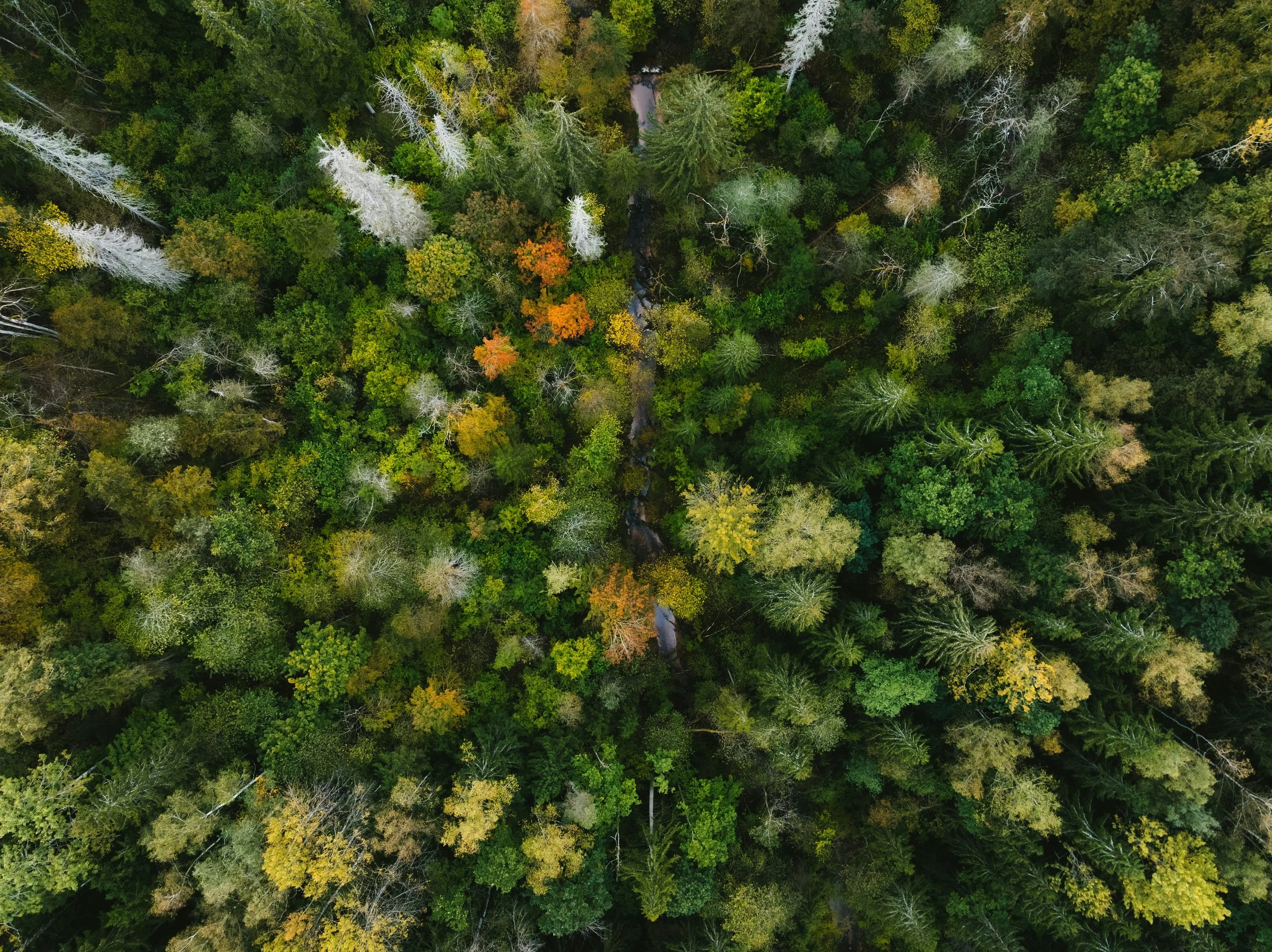
Photo by Kristaps Ungurs on Unsplash
A different way of meeting complexity
What we’re calling for here is not that we add yet another item on our to-do list. It’s not an extra check box on our reporting sheets. It’s not even really something else that we would have to ‘do’ more of. Rather, it’s an invitation to shift the way we do what we’re doing already.
We can only ever ‘do’ specific things, contextually, place-based, with defined focus and intention. And, this underlayer, as a subject of our shared care and concern, is not something we can reach by zooming out, detaching from the local and concrete contexts we are anchored in. Rather, we encounter it inside the specific, when we stay with something long and deep enough to feel how it extends and connects all the way across. How the forest is also a watershed, a carbon sink, a set of land rights, a basket of memories. How the classroom is also an economy, a culture, a material structure, a future for the community.
Still, as we take specific action in a specific context on a specific challenge, we can relate with everything else, stay in connection with other contexts, further away from us, and interdependent with ours. Relating like this is not passive: it shapes what we consider, how we discern, what we decide, what we do, and how we do it, from which inner aptitude. We can learn to sense this underlayer present in all our focused work, in all the things we do locally. And simply by sensing it, inviting its presence in our attention and our bodies, we’re already beginning to rebuild the web of relationships that supports us and everything alive.
Why we are writing this series
The three of us, Luea, Julien, and Claudian, work on systems-scale issues, as do many of the people around us. We have been trying, separately and together, to understand what this type of work actually requires of us: not just the outer strategies, but the inner and relational capacities that make genuine transformation possible and sustainable over time rather than merely performative.
That inquiry led Julien and Luea to write Soundtracking, a book that attempts to demystify and articulate the inner work of process stewardship: how it practically works, and what it demands (currently in the final stages of editing). It also informs the work of Dragonfly Zunft – a guild of practice for systems change and long-arc transformation, which developed and is working with Synergy Thinking, as a way to activate what is already present but not yet in motion – co-founded by Luea and Claudian, and with which this series is in active dialogue. It is more generally informed and inspired by our experience in a range of organisations and ecosystems – some we (co-)steward, some we contribute to – too many to acknowledge here.
The present series of texts is a companion to that ecosystem of work, and an extension of it. It raises a series of questions that underlie our diverse contributions and fields of work, questions that we believe are important, and that we invite you to gather with us around.

Photo by: Christopher Burns on Unsplash
Naming the underlayer
Core to this series is an attention to what we call the underlayer of systems transformation work. We propose that there is a substrate of capacities, relationships and conditions that makes everything else possible, yet is rarely named or tended to directly. Like soil, it will not call to us as urgently as what grows in it. Its work is largely invisible, but essential. This underlayer is harder to feel empathy for, in the same way that it is harder to care for depleted soils than for endangered animals. Which is why it is particularly important to name it. And it is something we must take responsibility for. No matter what is in your custody, no matter what your subject of care and concern is, looking after it requires at least some measure of attention to the health of what lies below, since it depends on it to thrive.
Hence also, though it might appear as such, this underlayer is not entirely hidden or beyond reach. We sense it calling for care and finding its way into our shared awareness through whatever place, community, cause or concern we care about. It appears as threads, alive in the work we witness and the discourses we hear around systems transformation. It is palpable in all the places where something is asking for more attention, more care, more coherence.
Our intention is to invite a shared conversation around this underlayer, as a shared commons. We’re hoping to articulate what we sense is at work in and around it, test our own understanding, and hopefully find resonance with others.
Five threads for exploring the underlayer
For now, we see five different threads running in this underlayer.
Expanding our field of attention: how to develop wider awareness, or what we might call our attentional capacity, even as we focus on specific issues and places.
Growing the connective tissue: how to expand our ways of knowing and our relationships to sustain that deeper, broader and wider attentional capacity.
Celebrating seasoned practitioners: how to recognise and develop the subtle, specialised capacities that are needed for leading and stewarding such relational and transitional processes.
Creating synergies in the broader environment: how to build a shared language and ways of working across among funders, decision makers, and partners, to better understand and care for this deeper layer.
Embracing transformation inside-out: how to create supportive environments for practitioners as they engage in the inner aspect of the work, where stewarding transformation involves a form of making oneself available for energetic metabolising.
Clearly, those threads are interconnected. Yet, we will consider them separately, in five different texts, as a way to help keep the conversation precise.
An invitation
We are writing this series for anyone who cares about ‘the world’ in the sense that we have tried to describe. Potentially, that is everyone. And, we write more particularly for those who have taken on responsibility for broader patterns in the system: practitioners, process stewards, funders, community builders, leaders who sense that the work of caring for the planet requires something not yet well named.
We offer this not as a programme or a manifesto, but an attempt to name what we are sensing, as an act of care. If it resonates, we would love to hear from you.
This essay is part of a six-part series by Luea Ritter, Julien Leyre, Claudian Dobos, exploring the underlayer of systems transformation work.